Sunday, 4 December 2011

Old Carrickbrennan Church Co Dublin


                            Above Image: A view inside the Watchman's house


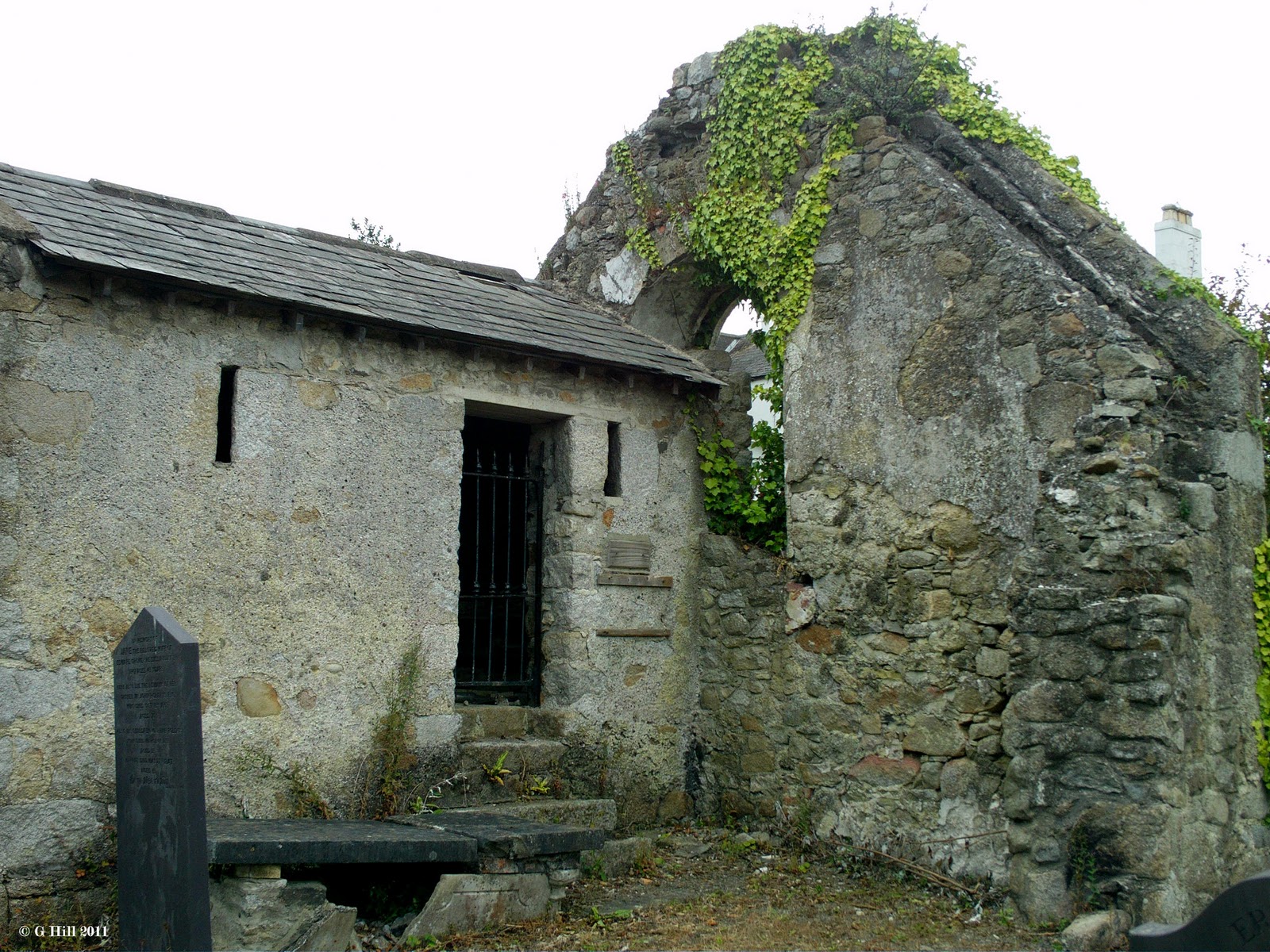
                      Above Image: The Old Church gable and Watchman's House.


The scant ruins of Old Carrickbrennan Church lie in a graveyard not far from the ruins of Monkstown Castle. The old Church is on the grounds of a medieval Cistercian Monastery which was dedicated to St. Mochanna. This building fell into ruin and in 1668 the present Church was constructed on the site. By 1777 it was deemed too small for use and was already in a ruinous condition.The graveyard was closed in 1874 due to fears of a Cholera outbreak, but was subsequently still in use for burials well into the 20th century.
Finding Carrickbrennan Church is quite easy. There is a gate in the surrounding wall on Carrickbrennan road. Access is not so easy as the site is in the care of Dun Laoghaire-Rathdown County Council. The gate generally remains locked and permission to enter has to be sought. Surprised we were then when we reached the gate to find it unlocked! We spent about a half hour having a look around. The site is surrounded by modern houses and I swore I heard someone shout "Get out of there!" at us at one point. Maybe someone thought we were trespassing and up to no good.
The old Church remains are scant. The gable still stands proudly but the rest of the Church has fallen to the test of time. The curious stone house attached to the rear of the gable is in fact a Watchman's house, built in the 19th century after the Church had ceased to be, but necessary to protect the graveyard from the scourge of body snatchers who were active at the time. The graveyard itself is said to be haunted by the spectre of the Widow Gambol who was hanged for the betrayal of Priests for monetary reward. We didn't meet the Widow thankfully. The graveyard is also notable as a burial ground for those who perished at sea in maritime accidents.
As mentioned, the site is in the care of the County Council and just as we were leaving a Council worker arrived on a bicycle and asked if we were finished. We said yes and he looked confused by our accents. Apparently an Australian visitor had requested the gate to be unlocked that day so he could search for ancestry, but he had long gone from the site. Lucky for us we were leaving when we did or we'd have been locked in for the night with the widow!
To find Old Carrickbrennan Church Take the N11 from Dublin to Wexford. Take a left hand turn onto the N31 Mount Merrion Rd. At the bottom of this Road at the T-Junction , turn right and continue on the N31 until you reach Temple Hill and the left hand turn onto the R119 Monkstown Rd. When you reach the Huge Monkstown Church the road forks left and right. Take the left and fork and then turn left again onto Carrickbrennan rd. The gate to the Site is on your left just before the roundabout where the ruins of Monkstown Castle stand (see post here) Seek permission first and don't stay too late as the gate will be locked!

Sunday, 27 November 2011

Old Confey Church Co Kildare


                        Above Image: The entrance to the copse, with paving stones  
                       

                                        Above Image: Further into the copse


                                             Above Image: The entrance gate


Secluded in a small copse in the northeastern section of Old Confey Cemetery stands the ruin of the Church of St Columba which although believed to have been constructed circa 1200AD, may actually predate the Norman invasion.The area of Confey was the site of a great battle in 917AD where the Norse King Sigtrygg defeated the King of Leinster.
The Church would have been built as a single-celled structure but the Chancel was added about a hundred years later. The building was in use until the 1700's when due to a lack of funding and poor parishioner attendance, it eventually fell into ruin. In an adjacent field there are the very scant remains of the once heavily fortified Castle of Confey now reduced to a small part of a Tower covered in Ivy.
In 2000AD the Kildare County Council conducted some renovation work on the old Church and added some paving stones for access and an Iron gate. They cleared away the undergrowth and for a time it remained so, but now unfortunately, as illustrated, the undergrowth is beginning to venture forward again and take hold.
You can access the old Graveyard by a gate or by a stile although the stile will lead you past a very sad part of the Cemetery dedicated to The Holy Angels, the graves young children who have passed away over the years.
In the far northeastern corner is a wooded area and it is within this area that you will find the old ruins. This section of the graveyard contains the more ancient stones and is more secluded. It seems totally distant from the otherwise inhabited district in which it stands. Once you step away from the paving stones the undergrowth is thick and deceiving. The whole area is not too far from the Royal Canal and the Rye Water Valley and some of the land around the ruins is quite marshy with underground streams apt to appear out of nowhere. A strange tract of land it is indeed.
It is possible to walk entirely around the Church ruins although loose rocks underfoot and thick vegetation make it necessary for the visitor to tread carefully. There is one point at the northern side of the Church where a deep ditch segregates the Church from the fields leading to the remains of the Castle. Beyond the ditch, barbed wire, boggy land and streams await those wishing to reach these scant remains.
You can enter the Church ruins through a gate and see the fine arch work within.Unlike some ruins we have visited Confey seems very peaceful and undisturbed. I wonder how many people actually visit? The area was completely empty when we made our trip.
To find Confey Church ruins take the Junction 4 exit from the N4 for Lucan Village. Once through the Village cross the Bridge over the Liffey and drive straight ahead towards the Laraghcon residential Estate. Go straight through the first roundabout and to the right at the second roundabout. Drive for about half a mile until you cross the bridge over the Royal Canal. take the next left onto the R149.Drive for about a mile until you see the area for car parking outside Confey cemetery on your right hand side.

Sunday, 20 November 2011

St. John The Baptist Friary Co Meath


This amazing Friary was founded in the 13th century by the then Bishop of Meath Simon De Rochfort for the Augustinian order of Monks known as the Fratres Cruciferi or Crutched Monks. This order specialised in the running of Hospitals and so the Priory was fitted out with that vocation in mind. The most prominent feature of the Friary is the tall three storey Tower house which was more than likely built for the Prior himself in the15th century. Adjacent to it is are the remains of a long two storey structure which was built earlier in the 13th century. The Friary was originally surrounded by a wall and a small defence Tower is still partially in evidence today a little to the south of the Tower House. The Friary was dissolved in 1539 and the last Prior was retired with a handsome pension of £10. The buildings were used for a time as a private residence and later as a Hospital in the 18th Century until eventually they finally fell into ruin.
This area of co Meath is littered with historical ruins. To the west stands Newtown Trim ruins and the famous Trim Castle while just across the River Boyne in almost a direct line with the other two is St John's Friary.
We parked by the old stone Bridge that crosses the Boyne and entered the Friary over a stile in the wall provided by the OPW. They have done a remarkable job in up keeping the area and there is full free access to the ruins which sit prominently in a field on the banks of the River. The Tower House looms above you as you enter the site and there are many nooks and crannies to explore.There are the remains of the Nave and Chancel which are among the earliest built.and a small vaulted sacristy which was added later. There is a great sense of peace about the place even though it is situated near a busy junction in the road and is one of the best examples of Augustinian ruins to be seen. Take a day to visit this fascinating ruin and the others that surround it.
To find the ruins of St John's, take the R161 from Navan towards Trim. Just as you reach the outskirts of the Town the is a turn left for the R154. Take this turn and after a short distance you will come to a large triangular junction which forks left and right. To the left is the stone Bridge. Immediately on the other side of the Bridge there is room to park at the entrance stile to the ruins.

Saturday, 12 November 2011

Maynooth Castle Co Kildare


                                Above Image: The entrance gate from within

                        Above Image: The meeting of the streams behind the Castle


The ruins of Maynooth Castle are situated at the entrance gate to St Patrick's College Maynooth. The Castle was built by the very powerful Fitzgerald family around the early 13th century and was strategically constructed at the meeting of the two streams " The Abhann Slad" and "The Lyreen" . The Fitzgeralds ruled the Barony of Naas for a long period and many of them became highly powerful figures such as The Duke of Leinster and Lord Deputies of Ireland. The Castle was constructed at the most westerly point of The Pale and apart from the Keep which was first built in the early 1200's the remaining ruins seen today are additional fortifications dating from the 1400's.
The castle fell to the English forces of Sir William Skeffington in 1535 after an insurrection by Silken Thomas Fitzgerald after his enemies had falsified reports and stated that King Henry had executed his Uncle for treason. By 1537 six Fitzgeralds including Silken Thomas had been caught and indeed executed leaving victory to his cunning enemies.
The Castle was restored from falling into ruin by Richard Boyle in 1635 as his Daughter had married George Fitzgerald, his ward, but following another attack in the 1640's, the Fitzgeralds finally moved out and eventually constructed the Carton estate nearby. The Castle remained uninhabited thereafter.
The remains you can see today are the great Keep, The Gatehouse,with the Boyle/Fitzgerald crest above the doorway and the Solar Tower which was a residential structure. Nothing remains of the great wall that surrounded the Castle apart from a fragment incorporated into St Mary's Church adjacent.
The Castle is open to visitors during May to September from 10AM , free admission, where you can visit the Keep and part of the Cellars. But there are fine views to be had from the outside and also from the riverside pier behind the castle.It is truly an amazing structure especially the lofty Keep. The Town of Maynooth being a University town is quite busy, even on weekends. Traffic can be a bit ,so if visiting, go as early as you can.
To find Maynooth Castle take the junction 3 exit for Maynooth/Straffan from the M4 Dublin to Galway. Upon exiting, take the right hand turn on the roundabout which crosses over the Motorway. This is the Straffan Road (R406/R405). After about a mile you will come to a T-Junction with the Main Street. Turn left and you will see the Castle ahead on your right. Parking is available around this area but limited, so drive around a bit or do what we did and park in the supermarket car park on the Kilcock Rd.


SECOND VISIT AUGUST 2018


We returned here recently when it was open to the public and managed to get inside the keep and around the inner walls. A very helpful lady gave us the full history and made the visit all the more worthwhile.