A guide to the best and sometimes off the beaten track historical ruins around Ireland and how to get there.
Saturday, 15 March 2014
Old Fossy Church Co Laois
Above Image: The roadside sign
Above Image: The view from the roadside
Above Image: entry gate and stile
Above Image: West wall entrance
We came across this nice little ruin on our way to Timahoe. It is located in a stone walled enclosure in pasture land about 100m from the roadside on a back road into the village.
The Church called Fossy (or sometimes Timahoe) was originally built in the late medieval period and apparently underwent some restructuring in the early 1600's. A Commissioners of Public Works document states that some repair work was carried out in 1903, this would have more than likely been preservation work as the Church had long been in ruins. All walls and gables still stand apart from a broken section in the South wall and the site has been under the care of the OPW since the mid 1940's. Throughout it's time the Church seems to have fared out better than a lot of it's contemporaries.
We thought that access to the location might be a problem as the ruins are surrounded by private pasture land but a roadside sign and stile proved otherwise. A short trek is all that is required across the field, which take note, can be a bit waterlogged in spots. About halfway across we encountered a wire barrier which had been strung across the length of the field presumably to deter cattle from wandering about but it wasn't electrified so it was easy enough to step under and continue on. In the distance a dog disturbed by our presence barked incessantly behind a wire fence in a nearby house but was of no danger to us. On reaching the Northern end of the enclosure wall there is another decently built stile to traverse and then you are there.
The Church itself is a simple affair, solidly built without any bells or whistles, but from it's vantage point it offers very picturesque views of the Laois countryside. Entry is through he arched doorway in the West wall and within silence is absolute. Outside there are some interesting old stones to be seen in the surrounding graveyard.
Worth a stop and a short trek if in the area and only a stones throw from the Timahoe monastic site.
To find the ruins take the Junction 17 exit of the M7 onto the roundabout and take the exit for the R423 (Abbeyleix Rd). On this road take the 2nd right hand turn at the cottage into Portlaoise retail park. Drive until you reach a T-Junction with the R426. Turn right and drive until you reach another T-Junction with the R425. Turn right again and continue on this road for approx.10KM until you reach the crossroads in Timahoe village. Go straight through the crossroads and take the first left turn beside the Tower Inn pub. Drive down this road for approx. 700m and you will spot the ruin in the field on your right. There is a field gate and stile with signpost. You can park a few yards beyond where the road is slightly wider.
Tuesday, 4 March 2014
Old Templetown Church Co Wexford
Above Image: The entrance gate and stile
Above Image: The entrance doorway
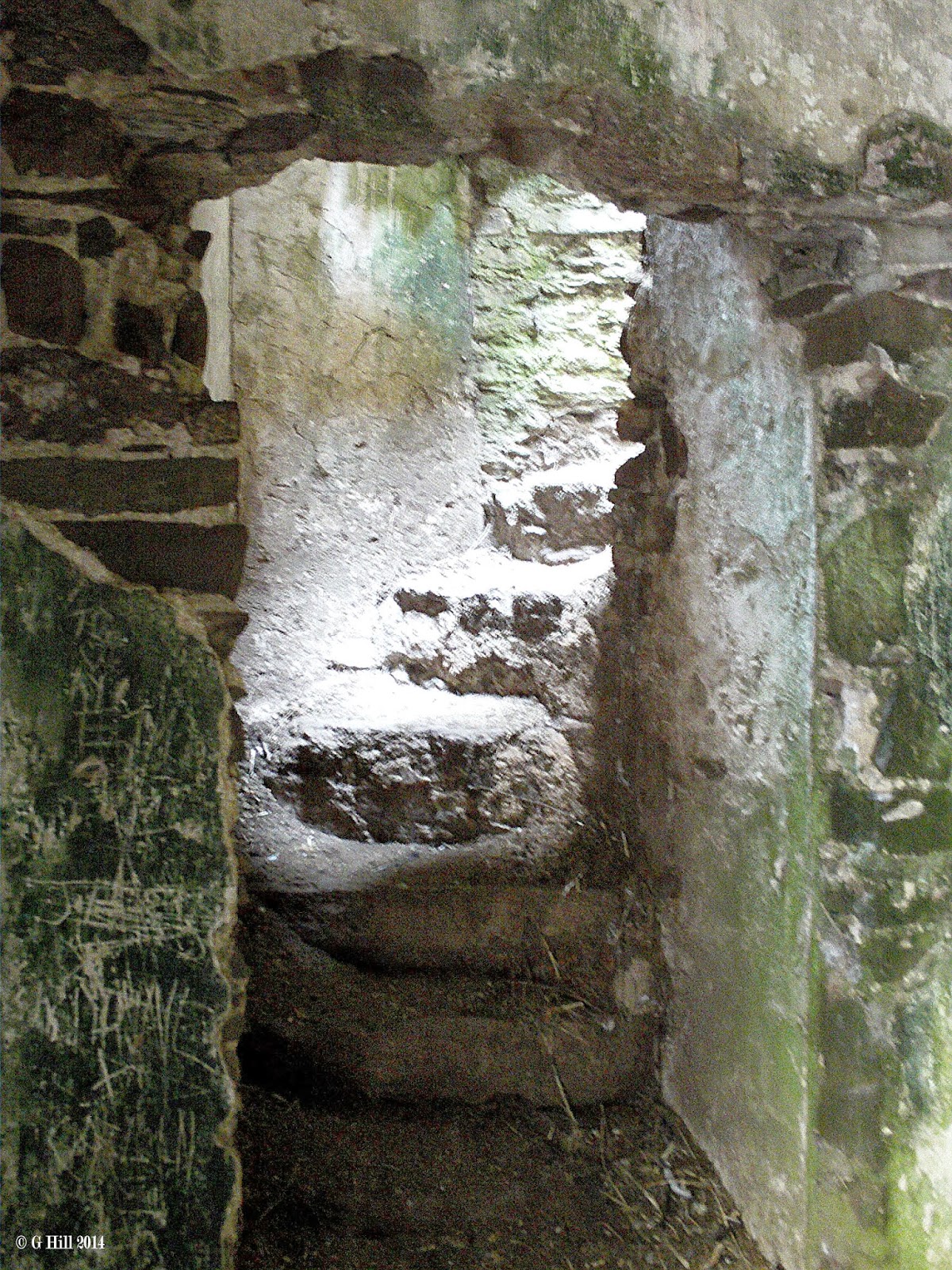
Above Image: The worn stairwell
Above Image: Upward interior view of the tower
Above Image: a fireplace on the first level
Above Image: Another upward view inside the tower
The Knights Templar came to a bad end in Europe in the late 13th century. Blamed in part for the loss of Jerusalem to Islam they found themselves dispossessed of their lands and wealth and in a lot of cases were tortured. In Ireland members of the order were incarcerated in Dublin Castle awaiting trial.
Templetown in Co.Wexford which had been granted to the Templars by Henry II after the crusades was passed on to The Hospitallers of St John, a rival order. They built the medieval tower at Templetown on the lands where the old Templar Church stood. For how long the tower was in use is vague but in the early 19th century a new Church was built alongside it and the tower adapted as a sacristy for the minister of the Church of Ireland. It remained in use until the mid 1800's and was then abandoned as the congregation moved to an even newer church of St Mogue's.
These ruins are certainly a bit of a mish mash. There are only scant remains of the original Templar Church but the medieval tower is quite impressive. It stands four storeys high and has crenellations on top. The old 19th century church has all of it's walls standing but is completely roofless and is joined to the tower by an extension where the entrance door lies. While the newer church section is fairly ordinary, the inside of the tower holds interest. There are a few rather rugged stone steps in one corner of the base from where you can ascend to the first floor level. It's a bit precarious but from up here you can see right up through the upper sections where floors are no longer in existence.
The ruins stand on a grassy mound elevated from the road and are surrounded by an old graveyard with some interesting stones. You can access by a stile by the dilapidated gates at the roadside. After your visit you can refresh yourself at the Templar Inn across the road..
To find The ruins take the R733 South from New Ross towards the Hook Peninsula. Drive for approx. 21Km until you reach Ramsgrange. Continue on through the village and drive approx. 700m until you reach a crossroads with the L4045. Turn right here (The sign says Hook Head 15KM) and drive for approx. 8KM until you reach the Templar Inn on your left. You can't miss the ruins opposite.
Monday, 17 February 2014
Derrylossary Church Co Wicklow
Above Image: The entrance gate
Above Image: View of the interior
Above 2 Images: The bullaun within the grounds
Above Image: The proximity of the outer bullaun to the West wall
Above 2 Images: The bullaun outside the wall
This is a fairly recent ruin the last service being held here in 1968 and then abandoned due to diminishing patronage. In the mid 1980's the Church was stripped of it's roof and laid bare to the elements.
The Church is made up of two sections the original part was a simple nave and was depicted in a drawing by George Petrie in 1820. Around that time an expansion was made to the Church and a tall bell tower was added in the 1830's. It is believed that remnants of the medieval Church that stood here are included in the Prue-expansion section. The site although designated Church of Ireland contains many Roman Catholic graves. One notable grave in the Churchyard is that of former President of Ireland Erskine Childers.
While the ruin itself is aesthetically pleasing to the eye sitting on a hill adjacent to Scarr mountain and surrounded by bucolic countryside it is inaccessible unless you clamber in through one of the window apertures. But it is really fairly plain inside not full of nooks and crannies like the medieval Church ruins and so not worth the effort. The tower itself also remains locked. Interestingly enough there are a number of bullaun stones in the area and two of them lie close to the ruins and are worth seeing.
The first stone is situated within the graveyard down a set of stone steps near the West wall near the bell tower. It contains two "cups" one 6" in diameter and the other 14". The second stone is in a field just over the West wall. This contains three "cups" one measuring 12.5" another 11.5" and a third partially formed one at 7". These bullauns are fascinatng and are generally thought to be designed to capture rainwater for healing purposes. Some are also thought to be utilised to grind corn. A word of caution, if climbing over the wall to see the outer stone be wary of the capstones on the top of the wall as some are loose. I found this out the hard way when one of the larger ones came loose and dropped hard only millimetres from my foot!
Allin all a mixed bag then but a very attractively placed ruin with some interesting features. Worth a stop if in the area
To find the ruins take the M11 Dublin to Wexford motorway and at junction 15 take the exit for the L5067 heading West. At the junction with the R764 turn right and drive for approx.12Km until you come to a junction with the R755 signposted for Laragh. There will be a large Church in front of you at this junction. Turn left and drive for approx.1.5KM until, you see a left hand turn for the L5077 and a sign pointing to Derrylossary. You will find the ruins about 150m down this narrow road on the left.
Thursday, 6 February 2014
Rathmacnee Castle Co Wexford
Above Image: Lane way and bawn
Above 2 Image: Views of the complete bartizan
Above Image: The tower, entrance and machiolation
Above Image: Close up of the machicolation
Above Image: Entrance arch with modern dwelling
Above Image: Inside the ground floor chamber
Above Image: Steps from the ground floor upwards
Above Image: Great fireplace on floor above vault
Above Image: A garderobe?
Above 3 Images The walkway at the tower top
Above Image: Steps leading to the bawn walkway
One of the nicer castle finds in County Wexford, Rathmacnee lies well off the beaten track down a lane way but is a must to make a visit to.
It is believed to have been built in 1451 by John Rossiter whose family owned and kept a number of castles in this area. They were disenfranchised of all their possessions by Cromwell in 1650 but Rathmacnee remained in use until the 1760's then afterwards fell into ruin.
The tall five storey tower is situated at the South East corner of a five sided bawn most of which still stands apart from a large section of the South wall. A modern house has been incorporated into the West wall and it is here that you can obtain a key to access the tower.
As you enter through the arched bawn gate you will notice a large machicolation above it which would have been used to pour boiling liquids and such down upon any assailants.
The castle and bawn are tucked neatly alongside an adjacent churchyard in a lane way. The tower on first view leaves a lasting impression as it dominates the site. The entrance gate leads you into what would have been the courtyard but is now a well manicured garden for the house. It is possible to ascend a set of steps just inside the gate on the right which brings you up to a wall walk on the bawn. On the bawn itself are two rounded bartizans one of which is incomplete. But by far the most interesting feature is of course the tower. Once inside you are confronted with a murder hole above the doorway, a set of stone steps to your left and a large vaulted chamber directly ahead of you. This chamber is quite large and covers the height of two floors. Above the vaulted ceiling is the stone floor of the third level which you can access. The steps from there lead all the way to the top and are steep and narrow in places. All the flooring above the third level is missing as is the roof. Some of the walls have mural chambers.
When you reach the top you can access most of what is left of the wall walk. At most times this is kept locked as according to the owners schoolchildren frequently visit and the walkway is not railed.
The top of the tower is crenellated and there are corner turrets all adding to the unique and decorative look. The views from up here are really worth the climb and from this aspect you can peer back down into the innards of the tower to the various chambers and fireplaces.
We called in here on a summer evening and found the owners quite friendly. We also had the castle to ourselves to explore which is always a plus. We were really excited by our visit here as there was quite a lot to see and the clambering about gave us the appetite we needed to tackle a dinner back at he Hotel at which we were staying. The site is a national monument and there is some information posted on the tower wall.
If you like climbing this one is definitely for you.
To find the ruins take the N25 Wexford to Rosslare road and approx. 2KM after the Rosslare road roundabout you will see a right hand turn for the R739 to Kilmore Quay. Take this turn and drive for approx. 2KM and take the 2nd turn right that you come across. Drive again for approx. 600m and you will see a sign for the castle pointing right down a narrow lane with a walled graveyard and the ruin of a recent church adjacent. You can park safely at the end of the lane.
Subscribe to:
Posts (Atom)