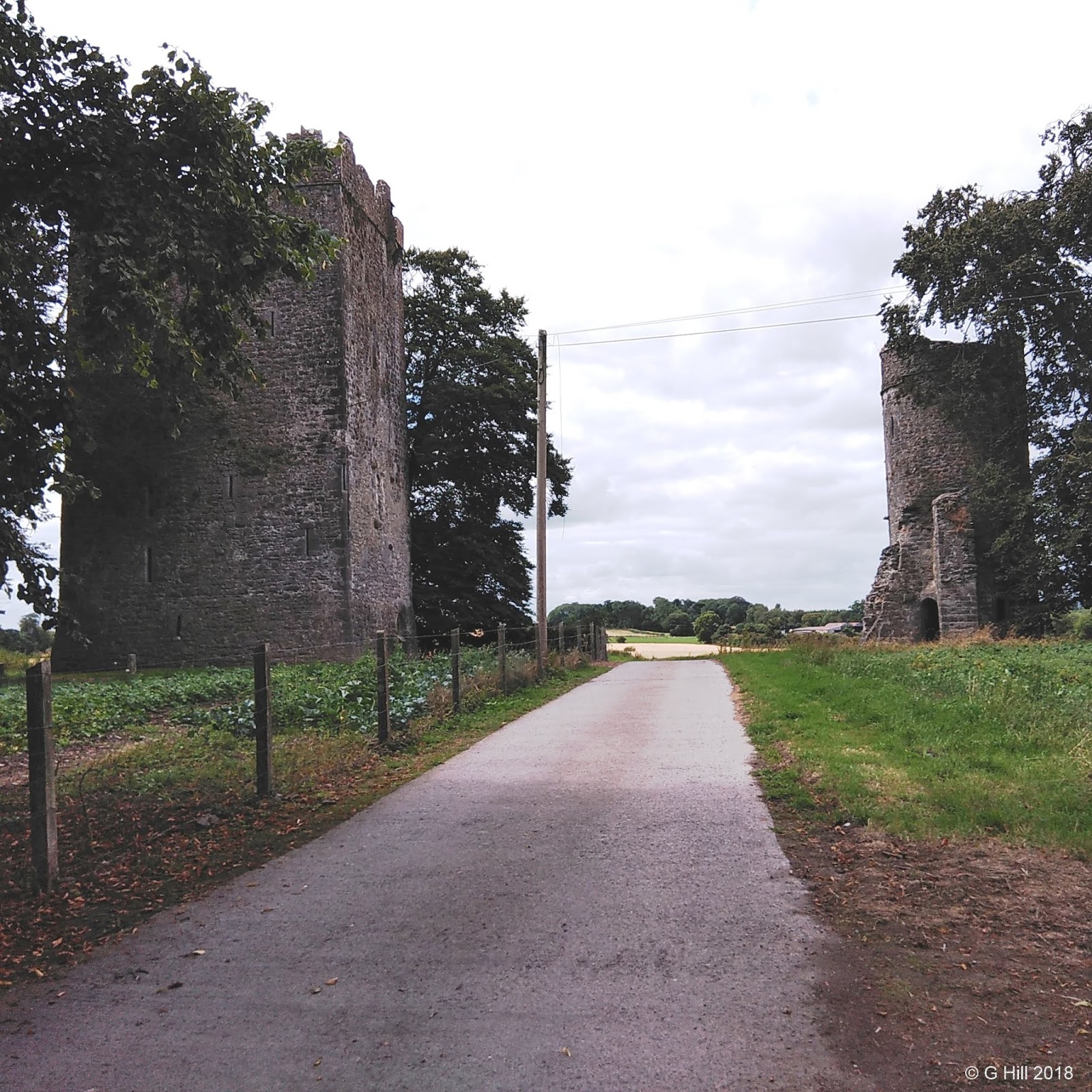
Above Image: The entrance gate
Above Image: The imposing tower.
Above Image: Entrance door with anxious visitor.
Above Image: The stone tower stairs
Above Image & Image Below: The upper floor room
Above Image & Below 5 Images: Some of the curiosities
Above Image & Image Below: Creepy alcoves
Above Image: The door to the Bloody Chapel
Above Image: The oubliette
Above Image: A hidden stairs from the bloody chapel
Above Image & Image Below: within the bloody chapel
Above Image & Image Below: View of the ruins from the chapel
Above Image & Image Below: The ruined parts of the castle
Above Image: Interesting door knocker
Leap Castle (pronounced Lepp) originally consisted of just the tower house and is thought to have been constructed by the O'Bannon's in the 13th/14th century. Its original name was "Leap of the O'Bannon's" and was strategically positioned on a huge rocky outcrop on an important pass in the Slieve Bloom mountains.
In 1513 the castle was attacked by the Earl of Kildare who was unsuccessful in his attempt to seize it but on a second attack in 1516 he caused severe damage but gained possession. It would remain that way until the O'Carroll's took possession a number of years later. The O'Carroll's were going through a period of feuding within the family in regards to leadership. One of the O'Carroll's was a priest and was butchered in front of other family members by his brother while hosting mass in the chapel at the top of the tower. As a result of this chapel would later be called "The Bloody Chapel".
Over subsequent years the castle would change hands .The Darby family family took possession in 1659 and later in the early 1900's a descendant Jonathan Charles Darby made extensive additions to the tower adding more residential space. His wife Mildred was a writer and dabbled in the supernatural holding seances in the castle and also widely promoted the castle as being haunted. It is said that the costs of building the additional space gave rise to the raising of rents of local tenants and of course Leap like many large Anglo-Irish houses was burned in the civil war of 1922.
An Australian historian named Peter Bartlett bought the ruins in 1974 as his family on this mother's side had been O'Bannon's. He spent 15 years renovating parts of it but unfortunately died leaving it still mostly in ruin. The present owner a noted musician skilled in the playing of the tin whistle is Sean Ryan. He bought the castle in 1991 and to this day has renovated the South wing and the ground and first upper floor of the tower.
Curiously we had visited Leap once before just before Sean Ryan bought it and it was still quite ruinous. We managed to find our way into one of the buildings attached to the tower. Within the roofless ruins a large tree was growing up and our arrival caused a large number of jackdaws to flutter around wildly and we were actually driven out by a swarm of insects we had obviously disturbed. looking back at the open black holes that were once windows I have to say it felt like we were being ushered out unceremoniously. I remember looking up Leap later in our local library (no Internet for us then!) and found out about its bloody history and of the 30 or more ghosts thought to inhabit it. Apparently it is deemed the most haunted castle in Ireland. In a conversation on our recent visit with Sean he explained that the jackdaws were constantly there destroying the castle steps with their droppings and that the insects we had encountered were most likely flying ants which he said plagued the ruins.
So here now 27 years later I managed to get hold of Sean by phone and arranged to make a visit.
We arrived at Leap on an overcast day which only lent more atmosphere to the place. A number of fairly friendly cats roam the grounds and some of them decided that our car was good place to sleep. Three of them nestled on the bonnet and roof.
Sean met us at the door and invited us to the fireside and gave us the history of the castle. He is a very genial man and a great storyteller and I asked him about living with these ghosts. He said that they don't really bother him they make their presence known doors opening and closing and sometimes the chattering of a large amount of people which stops suddenly when investigated. He said some visitors have seen the "Red Lady" who haunts the castle clutching a dagger. Others have seen little girls playing in the hall one who Sean identified historically had tragically fell from the parapet and died. The tower stairs holds the presence of some horrible entity which exudes a foul smell and the atmosphere within the bloody chapel has actually made some people feel faint.
What really made the trip even better is that after our conversation Sean handed us a torch and sent us off on our own to explore the tower and chapel. The first room we encountered was on the first floor. it had a long table with chairs, a large fireplace and many nooks and crannies. A couple of beds are also here and a collection of odd art and curiosities adorn the shelves and walls. This is apparently where in the past several psychic investigators and television ghost hunters have set up camp. It is a room both pleasing and unsettling and I'm sure it would feel much different after dark.
The next level was filling me with both anticipation and dread. This is the top floor and the site of the bloody chapel. It is still in ruin with no glass in the windows so the wind blows through it. It is dark and ominous and as we walked around it did make me fell a little unsettled. In one corner is the hole in the floor which led to an oubliette, a small chamber full of spikes where people were thrown into never to see light of day again dying in agony from their wounds. Hundreds of bones were removed from the oubliette during renovations.
From one of the open windows you can look down upon one of the the ruinous wings of the castle and also out onto the plains below the rear of the castle and the rock it is built upon.
We must have spent an hour and a half wandering and revisiting rooms. There are many little alcoves dark and uninviting but we never saw anything unusual. The only thing that was odd was a series of knocking sounds while we were talking to Sean but he didn't seem fazed at all. I guess he has just gotten used to the sounds and such of the castle be they supernatural or not.
The tour is available on weekdays but you need to call Sean in advance so he can arrange to be there.
A small donation of €6 per person towards the renovation is suggested but not asked for. But it is worth every cent and is going to a really good cause.
The telephone number for tours is 0868690547. The Email is seanryan@mail2web.com.
To find Leap castle take the M7 Dublin to Limerick road and exit at junction 22 for Roscrea. At the top of the exit ramp turn right onto the N62. As you approach Roscrea there is a roundabout called the Templemore Road roundabout with a McDonalds situated there. Turn left off the roundabout onto the R445 and drive until you reach another roundabout where you take the second exit to the right. Continue on this road which will lead you through part of Roscrea town until it the becomes the R421 on exiting the town. Continue for approx 6KM until you reach a left hand turn with a small cottage on the corner with the name Breretons Bar. Turn left here (it is signposted for Clareen) and drive for approx 4KM where you will reach the entrance gate for Leap on your right hand side. Drive through the gate and follow the track down to castle where you can park. Look out for the cats!